
Easings.net
by Andrey Sitnik (ai)
Cheat sheet of easing curves with visual previews, CSS cubic-bezier values and math functions for animations.
Web animation examples and effects Open sourceminimal
2. Commercial use: raw.githubusercontent.com
“You may charge any price or no price for each copy that you convey,”
Curve values pasted into your own styles are what the page is for; copying the site's GPL code into an app you sell makes the whole app GPL-3.0.
raw.githubusercontent.com3. Credit the author: raw.githubusercontent.com
“You may convey verbatim copies of the Program's source code as you”raw.githubusercontent.com
4. Agent access: github.com/ai/easings.net
There is no package or API. Files are downloaded by hand from the official site.
github.com/ai/easings.netLicense checked Nov 5, 2026 against 1 official page. Tap a verdict to see its source. How we checked Report an error
Easings.net: pick the right speed curve for animations
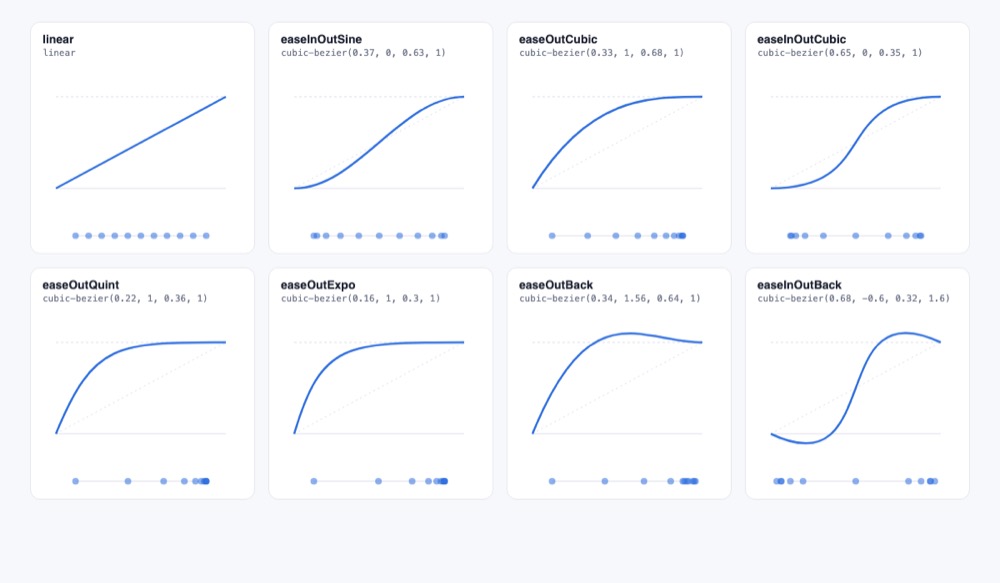
Easings.net is a free one-page cheat sheet of animation speed curves, such as easeOutCubic or easeInOutBack. Each curve is shown as a small chart, with a ready value to paste into your styles and a formula for code. It helps you make menus, buttons and pop-ups start and stop smoothly instead of moving at a flat speed.
Where you can use it
Menus and panels that slide naturally
Make a side menu, a dropdown or a modal speed up and slow down like a real drawer, by pasting one curve value into the animation style.
Animations started from code
Use the same curve value when an animation is started from a script, so code-driven and style-driven motion match.
A playful overshoot on buttons
Let a badge or a button pop slightly past its size and settle back, with the "Back" curves that go beyond the end point.
Bounce and elastic effects
Bounce and elastic curves have no single style value. The page shows how to build them as a keyframe animation instead.
Named curves in your build
Write the curve name in your styles and let a build plugin turn it into the right value, or draw smooth gradients with the same curves.
One set of motion settings for a whole site Idea
Pick two or three curves once and store them as named settings, so every animation on the site moves the same way.
Easings.net popularity
How to start
Tell your AI assistant
“Use easeOutCubic, cubic-bezier(0.33, 1, 0.68, 1), for opening menus and modals and easeInOutCubic, cubic-bezier(0.65, 0, 0.35, 1), for page transitions; store them as CSS variables, and do not copy code from the easings.net source (it is GPL-3.0).”
Mistakes to avoid
Handing out a work that contains the GPL code means licensing the whole work under the GPL.
Browsers know only a few named curves; the easings.net names need the value or a build plugin.
These curves are marked as having no CSS value.
The 1.56 control value pushes the motion past its end point (see easeOutBack in our demo); opacity cannot go above full, so the overshoot does nothing there.
License
GPL-3.0 (site source) license. The site's own code is under GPL-3.0. If you copy that code into an app you hand out, the whole app must be shared under GPL-3.0 too. The page's purpose is picking curve values for your own styles.
“You may charge any price or no price for each copy that you convey,” raw.githubusercontent.com
“You may convey verbatim copies of the Program's source code as you” raw.githubusercontent.com
“You may convey verbatim copies of the Program's source code as you” raw.githubusercontent.com
“You may convey verbatim copies of the Program's source code as you” raw.githubusercontent.com
AllowedWith conditionsNot allowedNot stated or not checked yet
Is Easings.net free for commercial use? The full answer Not legal advice. Check the license page before you ship.
For your agent
License rules tell your agent what it may do with Easings.net. Paste them into your prompt or AGENTS.md.
- Easings.net (Web animation examples and effects, UI animation (Lottie, Rive)). Cheat sheet of easing curves with visual previews, CSS cubic-bezier values and math functions for animations. Price: free; commercial use with conditions; no credit needed; ship inside your app with conditions; pass the files on to your users only with conditions. Style: minimal.
  Connect: download from https://easings.net (no API).
  Get files: Pick a curve on easings.net and copy its cubic-bezier() value or function into your CSS/JS (css, js).
  Not allowed: Site source is GPL-3.0
  Rule: Use it as a reference for curve values; copying the site's own source code brings GPL-3.0 obligations.
License: https://raw.githubusercontent.com/ai/easings.net/master/LICENSE (checked 2026-11-05; details: https://agentgid.com/assets/easings-net/)Agent copies the code, snippet or prompt from the page (no account).
Formats: css, js
Easing curves chosen with easings.netAlternatives
Easings.net This page
Pick Animate.css when you want ready-made effects such as bounce or fade added with one class name, not just a speed curve.
Pick GSAP when you need timelines, scroll effects or bounce and elastic motion driven from code.
Pick AutoAnimate when you only want lists and layouts to move smoothly on add and remove, with one function call.
Hundreds of official three.js WebGL/WebGPU examples (shaders, particles, post-processing, loaders) with full source in the repo's examples folder.
Gallery of React Three Fiber scenes (shaders, portals, caustics, scroll, physics, glass) linked to runnable sandboxes with source.
Questions
Can I use the curve values in a paid app?
The page exists to hand out these values for your styles. The GPL text covers the site's own code and does not mention the curve numbers.
What happens if I copy the site's code into my project?
The GPL-3.0 then applies to your project when you hand it out, so the whole work must be licensed under the GPL and its source offered.
Can I sell something that includes GPL code?
Yes, the GPL allows charging for copies, but the buyers get the same GPL rights to the code.
Why does my bounce curve not work as a cubic-bezier value?
Bounce and elastic curves have no cubic-bezier value; the page shows a keyframe animation for them instead.